
See the mechanism.
Understand
the why.
Build a clearer picture of medicine with English explanations and original teaching diagrams. Connect what you see to how the body works.
General pathology · Chapter 1 excerptOpen chapter ↗
subjects
chapters
reading editions
A different way to recall: Focus sessions & knowledge-song sing-alongs ↗
What would help you learn today?
Try a chapter. Make a connection.
Chapter 1 in these three subjects is open to everyone. Later chapters and all other subjects require active paid membership.
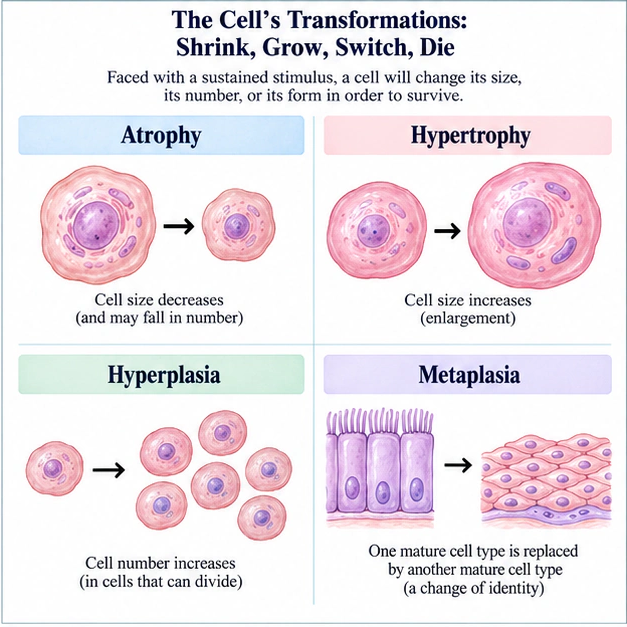
When cells
change their shape.
From adaptation to injury: follow the differences between shrink, grow, switch and die.
Read Chapter 1 02 / PEDIATRICSConsent.
Care. Clinical judgment.
Think through consent, assent and the ethical decisions involved in caring for children.
Read Chapter 1 Includes Taiwan-specific medical law examples. 03 / ENDOCRINOLOGYRead the slide.
Find the mechanism.
Connect adrenal pathology and hormone-producing cells to the story behind a tissue finding.
Read Chapter 1From a picture
to an explanation.
Follow mechanisms and the distinctions that make a topic click.
Use original teaching diagrams to connect structure, function and disease.
Explore clinical explanations alongside the illustrated study material.
Choose your next connection.
Browse the English edition, from foundational science to clinical medicine.
28 core subjects
General pathology
Cell adaptation, injury and disease mechanisms.
Chapter 1 freePediatrics & development
Child health, consent and developmental medicine.
Chapter 1 freeEndocrinology & metabolism
Hormones, glands and metabolic disease.
MembershipPhysiology
How the body works, from cells to systems.
MembershipIntegrative physiology
Connect mechanisms across organ systems.
MembershipAnatomy
Structure, spatial relationships and clinical anatomy.
MembershipCell biology & histology
Recognize the structures behind function.
MembershipEmbryology
Developmental pathways and congenital conditions.
MembershipBiochemistry & molecular biology
Metabolic pathways and molecular mechanisms.
MembershipPharmacology
Drug actions, indications and adverse effects.
MembershipCardiovascular medicine
Circulation, hemodynamics and heart disease.
MembershipRespiratory medicine
Ventilation, gas exchange and pulmonary disease.
MembershipGastroenterology & hepatology
The gut, liver, biliary system and pancreas.
MembershipRenal medicine & electrolytes
Kidney function, fluid balance and acid–base disorders.
MembershipHematology & oncology
Blood disorders, malignancy and tumor biology.
MembershipInfectious disease
Pathogens, host defense and clinical infection.
MembershipRheumatology & immunology
Inflammation, autoimmunity and systemic disease.
MembershipNeurology
Neural pathways, localization and neurologic disease.
MembershipPsychiatry & behavior
Mental health, cognition and behavioral medicine.
MembershipObstetrics & gynecology
Reproductive health, pregnancy and childbirth.
MembershipMusculoskeletal medicine
Bone, joints, muscle and movement.
MembershipDermatology
Skin findings and their underlying mechanisms.
MembershipOphthalmology
Vision, ocular anatomy and eye disease.
MembershipEar, nose & throat
Hearing, the airway and head and neck medicine.
MembershipRehabilitation
Function, recovery and rehabilitation principles.
MembershipAnesthesia, critical care & trauma
Acute assessment and physiologic support.
MembershipPublic health, statistics & ethics
Study design, population health and ethical reasoning.
MembershipAdditional clinical topics
Cross-disciplinary topics and clinical review.
No matching subjects. Try a broader term or clear the search.
Listen to the key points.
Each Otter Whistle album turns one subject's core study points into songs (Mandarin vocals). Links open Apple Music; full playback may require a subscription.
Catch the words as the song plays.
Pixel Rounds is an 8-bit lyric game built on the OET textbook songs: the music pauses before a medical term, you catch it from word cards or by spelling, and spaced review brings the lines you nearly forgot back to you. The whole interface and every key point are available in English.
Go beyond the first chapter.
Active paid membership unlocks the complete teaching library. A free account alone does not unlock paid chapters.
Membership uses a fixed reading period, with no automatic renewal. Games are a separate purchase.
30 days from activation
Planned membership option
1 year from activation
Planned membership option
A few useful answers.
Which chapters can I read for free?
Only Chapter 1 in General pathology, Pediatrics & development, and Endocrinology & metabolism. Later chapters and all other subjects require active paid membership.
Can I study in English?
Yes. The main entrance and English reading edition use English. Switch to the Chinese homepage using 中文. Taiwan-specific legal examples are identified where they appear.
Are the learning tools private?
Your focus goals, recall notes, review cards and saved songs stay in this browser on this device. They are not synced between devices. Clearing browser data removes them.
Can I buy membership or download the app now?
Reading membership can be bought on this page with a credit card, ATM transfer or convenience-store payment through ECPay; access starts automatically once the payment is confirmed. Online purchasing is not open yet. The Google Play release is not open yet. Existing paid members can sign in. Reading membership and the MediGame game pack are separate purchases.