At the Triangular Table: Ethics, Consent, and a Note That Must Not Be Written
Parents can say "yes" on their child's behalf, but they cannot say "I am willing too" for the child. For an invasive procedure that offers the donor no therapeutic benefit, both voices must be heard before it counts as complete.
Focus points for this chapter
Scan the topics first, then read the chapter in order.
- Physicians Act Article 11: If You Have Not Seen the Patient, You Cannot Write "He Is Fine Right Now"
- Consent and Assent: Children Have a Voice Too
- Disclosing Prenatal Abnormalities and Peer Complaints: Give Full Information, Withhold Judgment
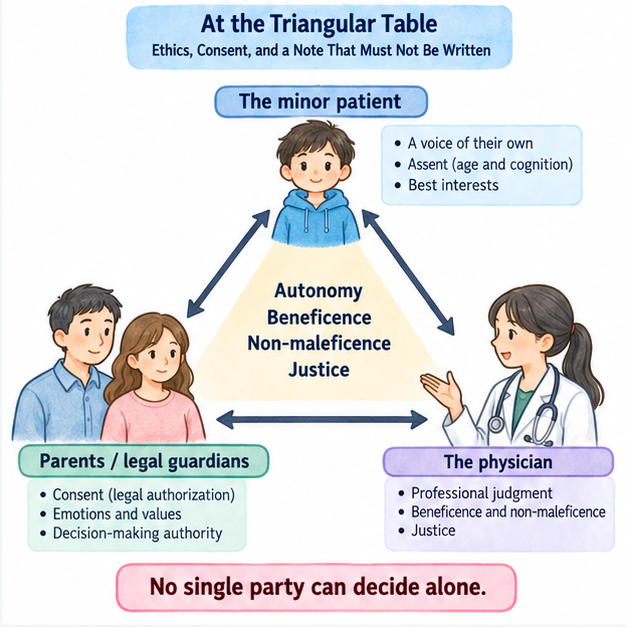
Study illustration: At the Triangular Table: Ethics, Consent, and a Note That Must Not Be Written
Full text
A couple arrives at the clinic asking the physician to write a note stating their child is "currently entirely normal," so that the child — who is at school and did not come in today — can make up a missed physical education exam. In the next room, a mother asks: "My eight-year-old daughter is donating bone marrow to her two-year-old brother. She's actually a little scared and flinches from the needle — but we adults have already signed the consent, so we can go ahead, right?" In neither scenario is anyone bleeding, yet both are the exam's favorite "which is least appropriate" questions.
The root of pediatric ethics comes down to one sentence: the minor patient, the parents, and the physician form a triangular table, and no single party can decide alone. The four principles of ethics (autonomy, beneficence, non-maleficence, justice) each have their seat at this table, but the single most common wrong turn is treating "the parents consented" as equivalent to "the child also consented." Hold onto this rule and half of the ethics questions solve themselves.
Physicians Act Article 11: If You Have Not Seen the Patient, You Cannot Write "He Is Fine Right Now"
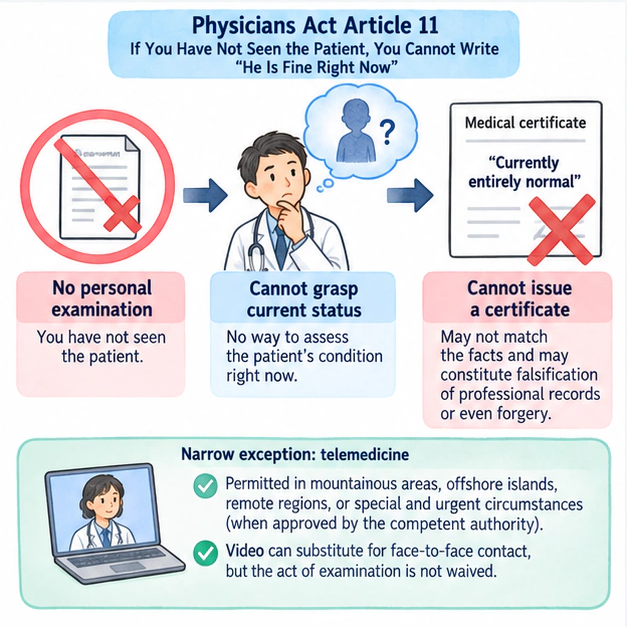
Study illustration: Physicians Act Article 11: If You Have Not Seen the Patient, You Cannot Write "He Is Fine Right Now"
The causal chain behind this rule is simple. A medical certificate is not a favor slip that says "I believe he's probably fine" — it is a legally binding assessment of the present moment. A physician who has not seen the patient → cannot grasp the patient's current status → so anything written as the "current condition" may not match the facts → and if something goes wrong, the law will not excuse you simply because your intentions were good. So the issue is never whether the patient was at school; it is that the words "assessment of current condition" must never be written unseen.
Full text
"Personal examination" is the hard threshold of medical practice. Physicians Act Article 11 states it plainly: a physician who has not personally examined a patient may not administer treatment, prescribe medication, or issue a medical certificate. Why? Because a medical certificate is a legal attestation of a patient's "current status," and without seeing the patient, there is no way to assess that status. Issuing a certificate stating "currently entirely normal" — a statement that assesses current condition — at the family's request, when the content does not match the facts, constitutes falsification of professional records or even forgery of documents.
There is only one narrow exception: mountainous areas, offshore islands, remote regions, or special and urgent circumstances, where telecommunication-based examination and prescribing are permitted once approved by the competent authority — this is the legal basis for telemedicine. Note that the exception permits substituting video for face-to-face contact; the act of examination itself is not waived.
Consent and Assent: Children Have a Voice Too
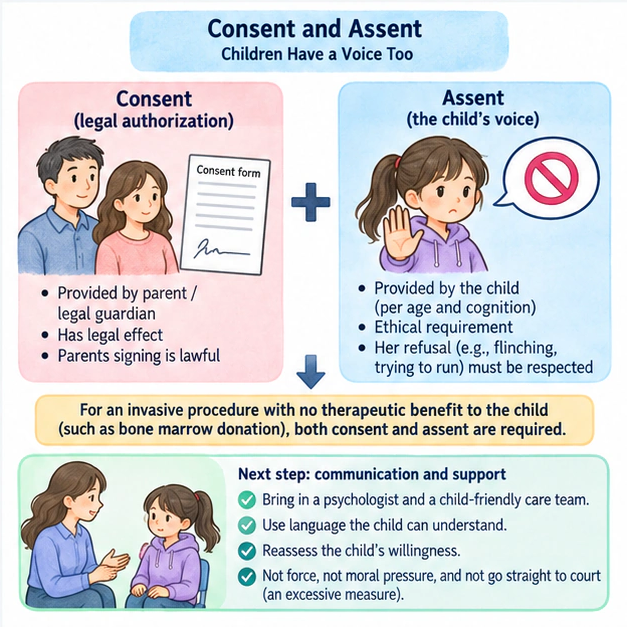
Study illustration: Consent and Assent: Children Have a Voice Too
Full text · 1 table
The second scenario, the older sister preparing to donate bone marrow, is the classic script for the distinction between consent and assent. One sentence captures the concept: parents provide "consent"; children provide "assent." When a procedure offers no therapeutic benefit to the child and is invasive, both are required.
| Concept | Who provides it | Nature | Meaning in this scenario |
|---|---|---|---|
| Consent (legal authorization) | Parent / legal guardian | Legal effect | Parents signing for the older sister is lawful |
| Assent | The child (per age and cognition) | Ethical requirement | The older sister herself must also agree |
Swipe or scroll sideways to compare every column; keyboard: focus the table and use arrow keys.
The crux of the bone marrow donation scenario is that it offers no therapeutic benefit whatsoever to the donor herself, and it is invasive (general anesthesia, bone marrow aspiration). In this kind of "for someone else, not for oneself" procedure, parental consent alone is not sufficient — every effort must be made to obtain the child's own assent. If, as the vignette describes, "the older sister flinches away and tries to run," that is not willfulness; it is her refusal expressed through behavior.
The correct approach is to bring in a psychologist and a child-friendly care team to communicate and reassess using language the child can understand — not moral pressure, not forcing her onto the table, and certainly not going straight to the courts, which is an excessive measure. Invoking the judicial system before the child has even been given adequate opportunity to communicate violates both the "best interests of the child" principle and the principle of "least harm."
Disclosing Prenatal Abnormalities and Peer Complaints: Give Full Information, Withhold Judgment
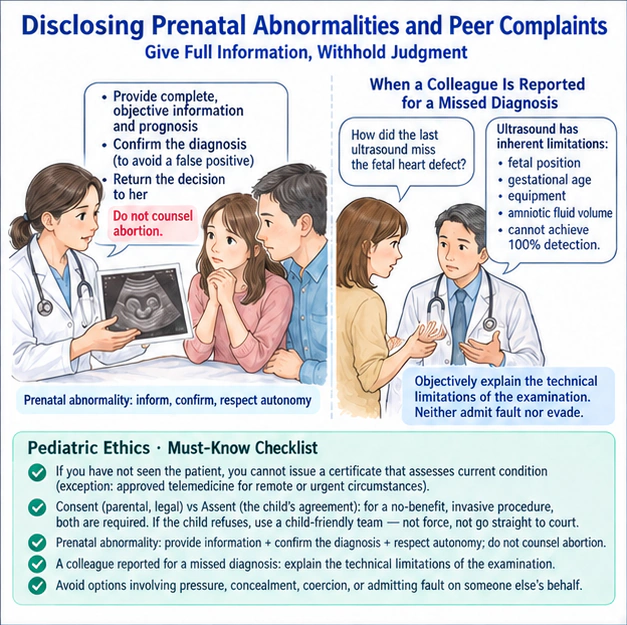
Study illustration: Disclosing Prenatal Abnormalities and Peer Complaints: Give Full Information, Withhold Judgment
- If you have not seen the patient, you cannot issue a certificate that assesses current condition (Physicians Act §11); the exception is approved telemedicine for mountainous, offshore-island, remote, or urgent circumstances.
- Consent (parental, legal) vs Assent (the child's agreement): when a procedure offers no therapeutic benefit and is invasive, both are required; a child's behavioral refusal should be met by bringing in a child-friendly team to communicate, not force, not going straight to court.
- Prenatal abnormality: provide information + confirm the diagnosis + respect autonomy, do not counsel abortion.
- A colleague reported for a missed diagnosis: explain the technical limitations of the examination, neither admit fault on their behalf nor evade the question.
- In ethics options, eliminate any choice involving "pressure, concealment, coercion, or admitting fault on someone else's behalf."
- Traps: (1) assuming "the parents consented = the child consented too" (for a no-benefit, invasive procedure like bone marrow donation, assent cannot be skipped); (2) assuming telemedicine "waives examination" (it changes the method, not the requirement); (3) treating "going straight to court" as the next step after a child's refusal (a child-friendly team and psychologist should be brought in first).
Full text
Once prenatal diagnosis uncovers a chromosomal or structural abnormality, the physician's role is not to choose on anyone's behalf, but to lay out the information fully and return the decision to her. Three things are non-negotiable: provide complete, objective information and prognosis; confirm the diagnosis (to avoid a false-positive misjudgment); and never actively counsel termination of the pregnancy. This last point is the one most often violated — actively urging an abortion overrides the principle of autonomy with the physician's own authority, and even if you believe it is "for her own good," you have already crossed the line.
As for the scenario of a colleague being reported — the family complains, "How did the last prenatal ultrasound miss the fetal heart defect?" — here neither extreme is acceptable. Flatly declaring a colleague negligent may harm that colleague and may not even be accurate; evading or deflecting violates honesty. There is only one correct posture: objectively explain "the inherent limitations of the examination." The sensitivity of prenatal ultrasound for fetal cardiac screening is inherently constrained by objective conditions such as fetal position, gestational age, equipment, and amniotic fluid volume — even the most thorough anatomical survey cannot achieve 100% detection. This speaks on behalf of reality, not on behalf of admitting fault or shifting blame for any physician.
Didn't see them? No "currently fine" note!
No benefit, invasive? Consent plus assent!
Child pulls away? Friendly team, not the court!
Prenatal news? Inform, confirm, don't urge abortion!
Colleague missed it? Explain limits: no blame, no dodge!
Pressure, concealment, coercion? Cross it out!
🎤 English rap lyrics — the chapter's study song (chorus = the mnemonics above)
The Note You Must Not Write
Verse 1
Kid's at school, parents want a note that says he's fine,
Article Eleven: never examined? Don't sign,
No exam, no treatment, no prescription, no certificate,
Unseen patient, "currently normal"? You can't assess it,
A certificate's a legal claim on the present state,
Write it anyway? Forgery; good intentions won't clear the slate,
Seen him yesterday? Still can't write "currently fine,"
Present status needs a personal exam, that's the line,
Mountains, offshore islands, remote or urgent, approved,
Telemedicine swaps the method, the exam's not removed.
Chorus
Didn't see them? No "currently fine" note!
No benefit, invasive? Consent plus assent!
Child pulls away? Friendly team, not the court!
Prenatal news? Inform, confirm, don't urge abortion!
Colleague missed it? Explain limits: no blame, no dodge!
Pressure, concealment, coercion? Cross it out!
Verse 2
Marrow for her brother: invasive, zero gain for her,
Parents sign the consent; her assent must still occur,
Consent: parents, legal. Assent: the child, ethical,
Invasive, no benefit? You need both, that's essential,
Parents can say yes for her, not "I'm willing too,"
She flinches, runs away: that's her no coming through,
Bring a psychologist, a child-friendly team, and talk,
No force, no moral pressure; court's too far a walk,
Prenatal abnormal: full info, prognosis, confirm the call,
Respect her autonomy, never urge termination at all,
Family asks how the scan missed the fetal heart defect,
Explain the limits: position, age, fluid; don't blame or deflect.
Chorus
Didn't see them? No "currently fine" note!
No benefit, invasive? Consent plus assent!
Child pulls away? Friendly team, not the court!
Prenatal news? Inform, confirm, don't urge abortion!
Colleague missed it? Explain limits: no blame, no dodge!
Pressure, concealment, coercion? Cross it out!
Bridge
Autonomy, beneficence, non-maleficence, justice: four seats,
Deciders: autonomy, honesty, the child's best interests.
Chorus
Didn't see them? No "currently fine" note!
No benefit, invasive? Consent plus assent!
Child pulls away? Friendly team, not the court!
Prenatal news? Inform, confirm, don't urge abortion!
Colleague missed it? Explain limits: no blame, no dodge!
Pressure, concealment, coercion? Cross it out!
Outro
All that says "currently" needs your own exam first,
Is it invasive, no benefit? Consent plus assent,
On a colleague's miss: explain the limits, no blame,
Lucid rule: inform, confirm, never urge abortion.
Close the book and recall
Say the answer in your own words or jot down keywords, then check each one. This is recall practice, not a past exam question.
What can you recall about “Pediatric Ethics · Must-Know Checklist”?
Once you have an answer, open the original to check
★ Must-know text from this chapter
Pediatric Ethics · Must-Know Checklist
- If you have not seen the patient, you cannot issue a certificate that assesses current condition (Physicians Act §11); the exception is approved telemedicine for mountainous, offshore-island, remote, or urgent circumstances.
- Consent (parental, legal) vs Assent (the child's agreement): when a procedure offers no therapeutic benefit and is invasive, both are required; a child's behavioral refusal should be met by bringing in a child-friendly team to communicate, not force, not going straight to court.
- Prenatal abnormality: provide information + confirm the diagnosis + respect autonomy, do not counsel abortion.
- A colleague reported for a missed diagnosis: explain the technical limitations of the examination, neither admit fault on their behalf nor evade the question.
- In ethics options, eliminate any choice involving "pressure, concealment, coercion, or admitting fault on someone else's behalf."
- Traps: (1) assuming "the parents consented = the child consented too" (for a no-benefit, invasive procedure like bone marrow donation, assent cannot be skipped); (2) assuming telemedicine "waives examination" (it changes the method, not the requirement); (3) treating "going straight to court" as the next step after a child's refusal (a child-friendly team and psychologist should be brought in first).
After checking, reread whatever you missed or mixed up, then try once more without looking.
★ High-yield points & traps from past exams (1 section)
| Exam point | Correct answer | Common trap |
|---|---|---|
| Medical certificate for a patient who has not come in | Must not issue one containing an assessment of current status (otherwise it is forgery of documents) | Issuing it outright at the family's request |
| Management after an abnormal prenatal diagnosis | Provide information + confirm the diagnosis; respect autonomy, do not urge abortion | Physician proactively urging termination of pregnancy |
| A colleague faces a complaint over a missed cardiac defect | Objectively explain the limitations of ultrasound screening | Confirming the colleague's negligence / evading the question |
| Bone marrow donation by a child | Besides parental consent, the child's own assent is still required; communication by a child-friendly team | Parental consent is enough / coercion / going straight to court |
| Assent vs consent | Child's assent + parents' consent; both are required for non-therapeutic procedures | Thinking only parental consent is needed |
Swipe or scroll sideways to compare every column; keyboard: focus the table and use arrow keys.
Answering-strategy reminder: For ethics questions asking for the "most/least appropriate" option, go back to the four principles; the deciding criteria are usually autonomy, honesty, and the child's best interests. Options involving "pressure, concealment, admitting fault on someone else's behalf, or coercion" usually point the wrong way.